
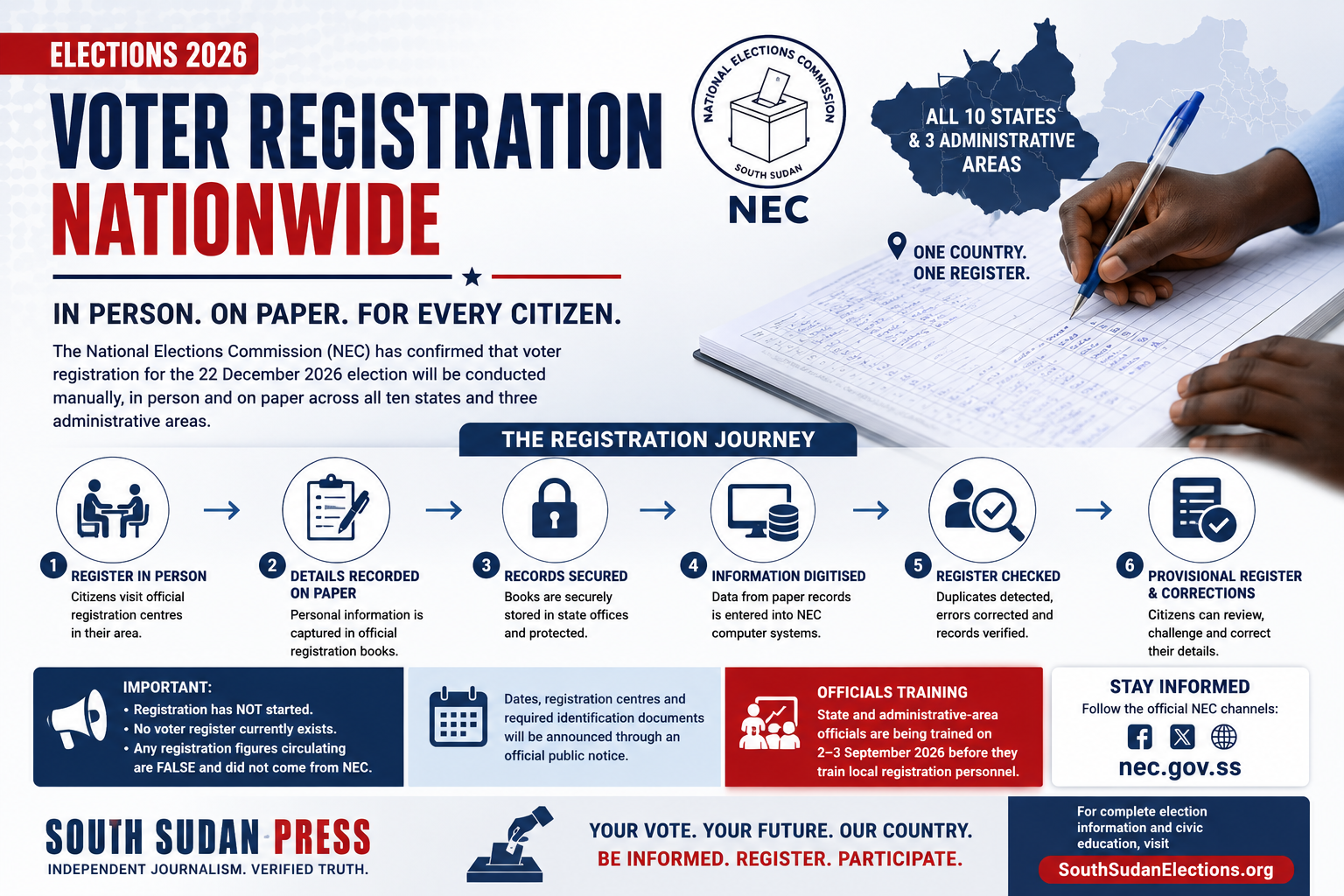
JUBA — South Sudan’s National Elections Commission has confirmed that voter registration for the planned 22 December 2026 general election will be conducted manually, in person and on paper throughout the country.
The NEC said the method will apply across all ten states and the three administrative areas. Information recorded in paper registration books will later be entered into the commission’s computer systems, while the original books will remain preserved in state offices as permanent records.
Registration has not started
The commission also moved to counter false claims circulating online, saying no voter has yet been registered anywhere in South Sudan and no electoral register currently exists.
That means there are no legitimate registration totals for any state or administrative area. Figures circulating online — including claims of 890,457 registered voters in “Bahr El Ghazal,” 71,908 in “Equatoria” and 55,723 in “Upper Nile” — were not produced by the NEC and do not correspond to any actual registration activity.
Myth vs Fact
MYTH: Voter registration is already underway.
FACT: The NEC says registration has not started anywhere in South Sudan.
MYTH: Regional registration totals have already been released.
FACT: The NEC says no electoral register exists yet and the circulating figures are fabricated.
MYTH: Paper registration was adopted specifically for Bahr el Ghazal.
FACT: The NEC says the method applies nationwide and was chosen with accessibility and literacy levels across the population in mind.
What the NEC is doing now
The commission says it is still in the preparatory phase. Electoral officials from the ten states and three administrative areas are being trained in Juba on 2–3 September on registration procedures, the electoral legal framework, registration forms, civic and voter education, and the management of equipment and data.
Those officials are expected to return to their jurisdictions and train local registration personnel before the exercise begins. The NEC also says State High Elections Committees are close to completing assessments of registration centres, while civic and voter education campaigns have begun in seven states.
What voters are still waiting for
The NEC has not yet issued the public notice that will designate the registration period and registration centres. The commission says that notice will be published through its website, verified social-media channels and national newspapers.
The complete public procedures have not yet answered several questions that will matter to voters: exactly when registration will begin and close, which identification will be accepted, what alternatives will exist for eligible citizens without standard documents, and how objections and corrections will be handled.
Paper registration is not inherently fraudulent
Manual registration is not, by itself, evidence of fraud or invalidity. The credibility question is whether the system has adequate safeguards from the moment a person is entered into a paper book until the information appears in the digital database and final register.
That means the NEC will need controls capable of preventing or identifying duplicate registrations, protecting registration books during transport and storage, reducing transcription errors during data entry and reconciling any differences between the paper records and the electronic database.
Public scrutiny will be crucial
The NEC has not yet publicly explained the full duplicate-detection method, whether parties and observers will have access to registration audits, or how citizens will inspect and challenge a provisional register.
Those issues will become more important as the election timetable advances. A credible voter register needs not only to include eligible citizens, but also to give citizens a practical way to verify that their information is correct and to seek corrections when it is not.
Follow South Sudan Elections 2026
For registration announcements, election timelines, constituencies and civic-education resources, visit SouthSudanElections.org.