In Fangak, Care Travels by Boat as Floods Put Clinics Beyond Reach
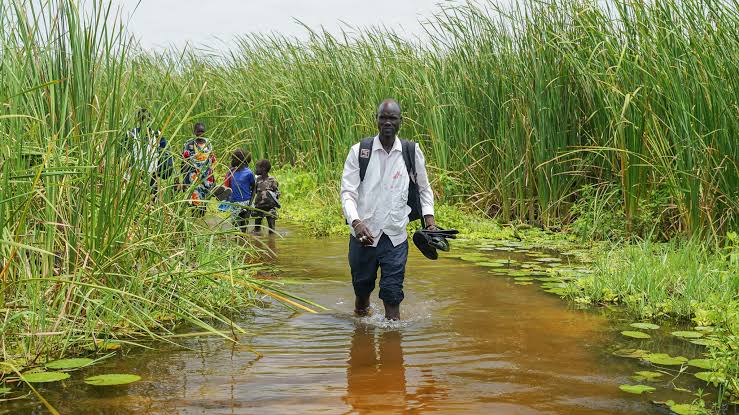
Supplied image: a person walks through floodwater. Photographer, date, precise location and subject identity have not been independently verified.
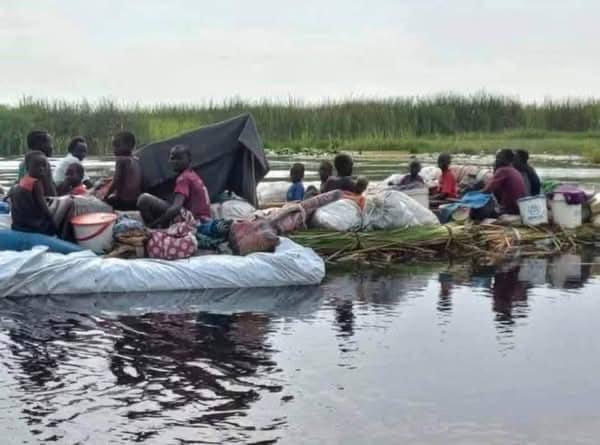
Supplied image: people and belongings on a raft. Photographer, date and precise location have not been independently verified.
FANGAK, 8 October 2026 — Years of flooding and conflict have pushed families onto scattered islands in Jonglei's Fangak County. For some, seeking treatment means waiting for a canoe, then making a difficult journey to a functioning facility.
Médecins Sans Frontières (MSF) says it began a community paramedicine programme in February to take consultations, maternal care and referrals closer to isolated households. The organisation estimates that the programme serves 25,146 people in Dhornor, Kuerbuay, Kuerdeng and Payiat. This is the programme's estimated service population, not a count of patients treated.
MSF says the May 2025 destruction of its Old Fangak hospital removed a major source of care, while funding cuts and insecurity have compounded access problems. It reports that more than one million people in opposition-controlled parts of Jonglei depend on two functioning hospitals that it operates. These are MSF's assessments and should be attributed as such.
Analysis: Bringing clinicians to islands addresses an immediate transport barrier, but small outreach teams cannot replace hospital surgery, inpatient treatment or reliable emergency referral. A community programme succeeds only if medicines arrive, staff can travel safely and the boat transfer to higher-level care works when a patient needs it.
The county's health response needs an accessible referral map: where each outreach team operates, what days it visits, which cases it can treat, and how patients are moved when boats or fuel are scarce. State authorities and aid agencies should publish and update that information through radio and local leaders, not only online.
What to ask next: How many consultations and referrals have occurred? Which islands remain uncovered? What is the average emergency transfer time? Is the programme funded beyond the current period? What is the plan for replacing Old Fangak hospital capacity?
Source: MSF Eastern Africa, 6 October 2026.