
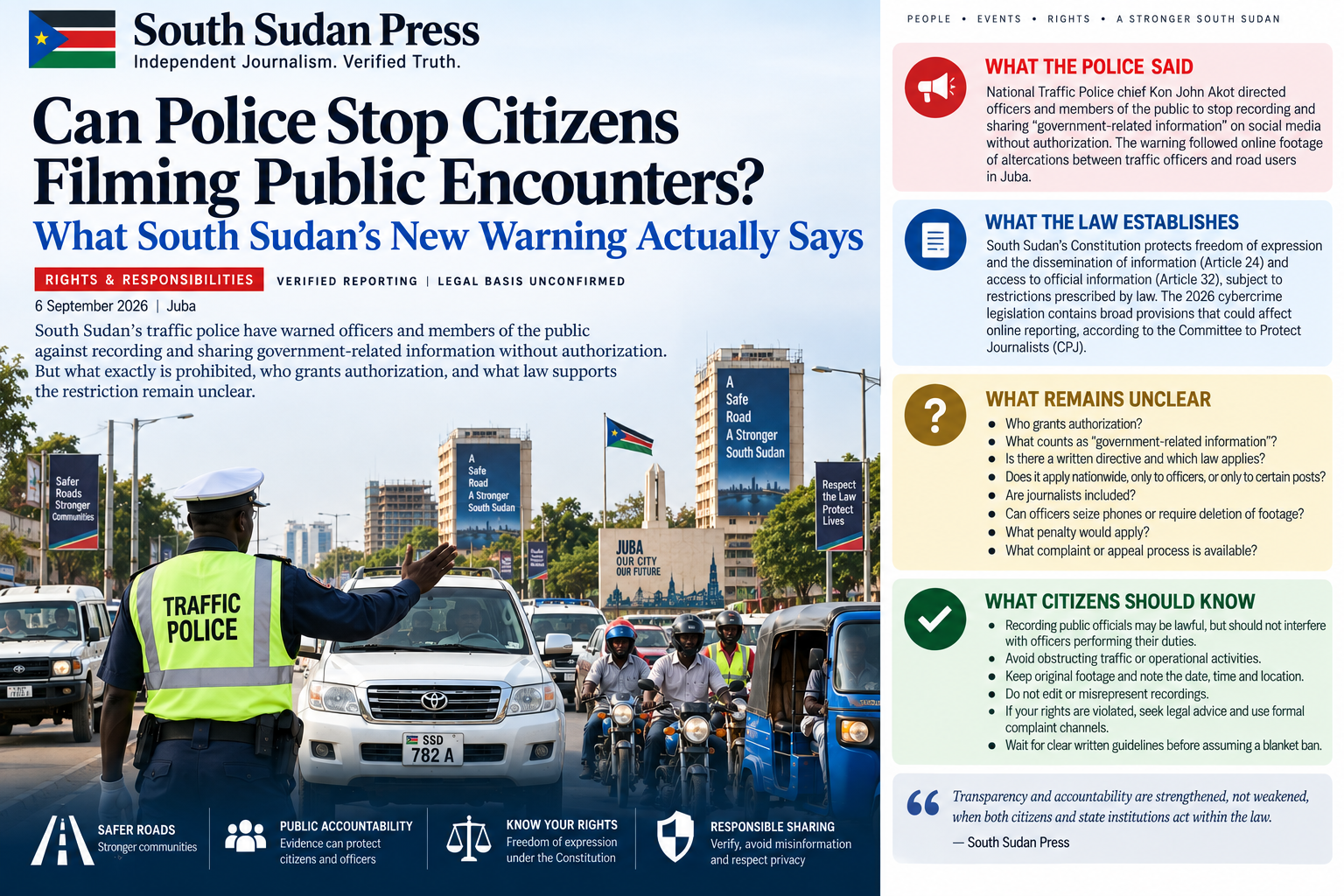
JUBA — A warning by South Sudan’s National Traffic Police chief Kon John Akot over the recording and circulation of government-related information has raised a basic but important question: does the instruction amount to a legal prohibition on citizens filming police and other public officials?
The remarks, reported on 6 September, followed videos circulating online showing confrontations between traffic officers and road users in Juba. Akot told officers and members of the public not to record and share “government-related information” on social media without authorization.
But the reported statement leaves important legal and practical questions unanswered. South Sudan Press has not seen a written directive defining “government-related information,” identifying who grants authorization, specifying an applicable penalty, or citing a statutory provision establishing a general prohibition on recording public officials performing their duties.
What the police said
The warning appears to have been prompted by concern over social-media videos involving traffic officers and motorists. Police leaders have separately urged traffic personnel to behave professionally and avoid physical confrontations with road users.
There is a legitimate public interest in preventing manipulated footage, misinformation, harassment and interference with police operations. But those concerns are not necessarily the same legal question as whether a person may record an encounter occurring in public.
What the Constitution establishes
Article 24 of South Sudan’s Transitional Constitution protects freedom of expression, including the reception and dissemination of information and access to the press, while allowing restrictions relating to public order, safety or morals where prescribed by law. Article 32 separately addresses access to official information and records, subject to lawful limitations including public security and privacy.
Those constitutional protections do not establish an unlimited right to record every government activity in every circumstance. Different considerations may arise where someone interferes with an operation, enters a restricted location, violates another person’s privacy, or handles lawfully protected information.
At the same time, South Sudan Press has not established that the 6 September remarks, by themselves, create a new offence or demonstrate the existence of a blanket nationwide ban on citizens recording police officers carrying out public duties.
What remains legally unclear
- Who is authorised to approve a recording?
- What precisely counts as “government-related information”?
- Does the instruction apply nationwide, only to police personnel, or to particular kinds of posts?
- Does it apply to accredited journalists?
- What written law or directive establishes the restriction?
- What penalty, if any, applies?
- Can an officer seize a phone or compel deletion solely because an encounter was recorded?
- What complaint or appeal mechanism is available?
Recording and publishing are not necessarily the same question
The act of making a recording, interfering with an officer, possessing sensitive information and publishing material online can involve different legal considerations. Treating all four activities as though they were identical risks creating unnecessary confusion for both officers and citizens.
Citizen footage can also have legitimate evidentiary value. A complete and authentic recording may document misconduct against a civilian, but it may equally protect an officer by showing that an accusation circulating online is incomplete or false.
The cybercrime law adds another layer
South Sudan’s Cybercrimes and Computer Misuse Act, signed into law in February 2026, has attracted concern from press-freedom advocates. The Committee to Protect Journalists has highlighted broad provisions dealing with unauthorized data, “undesirable content,” false or misleading information and offensive communications, warning that vague wording could create legal uncertainty for journalists and citizens.
That does not mean every recording of a public encounter falls under the cybercrime law. Rather, it makes clarity over the legal basis and scope of the traffic police warning more important.
What citizens should know for now
Until the authorities publish clearer legal guidance, citizens should avoid assuming either that all recording of officials is prohibited or that every form of recording is automatically protected. People documenting a public encounter should avoid physically obstructing officers or traffic operations, preserve original footage rather than misleadingly editing it, respect legitimate privacy concerns, and seek qualified legal advice where a dispute arises.
This article is a public-interest explainer, not individual legal advice.
What South Sudan Press is asking
South Sudan Press is seeking the written directive, if one exists, the statutory provision relied upon, the official definition of “government-related information,” the authorization procedure and clarification of whether the instruction applies to journalists.
Those answers matter beyond traffic enforcement. During an election period, uncertainty over whether citizens and journalists may document public officials can affect accountability, evidence preservation, public confidence and the wider civic space.
The central question therefore remains simple: what exactly does the law prohibit?
South Sudan Press verification note
The reported police warning is treated as confirmed reporting. The existence and scope of a general legal prohibition on filming public officials has not been established by the materials reviewed for this article. South Sudan Press will update this explainer if the Traffic Police or another competent authority publishes the written directive or legal basis.