
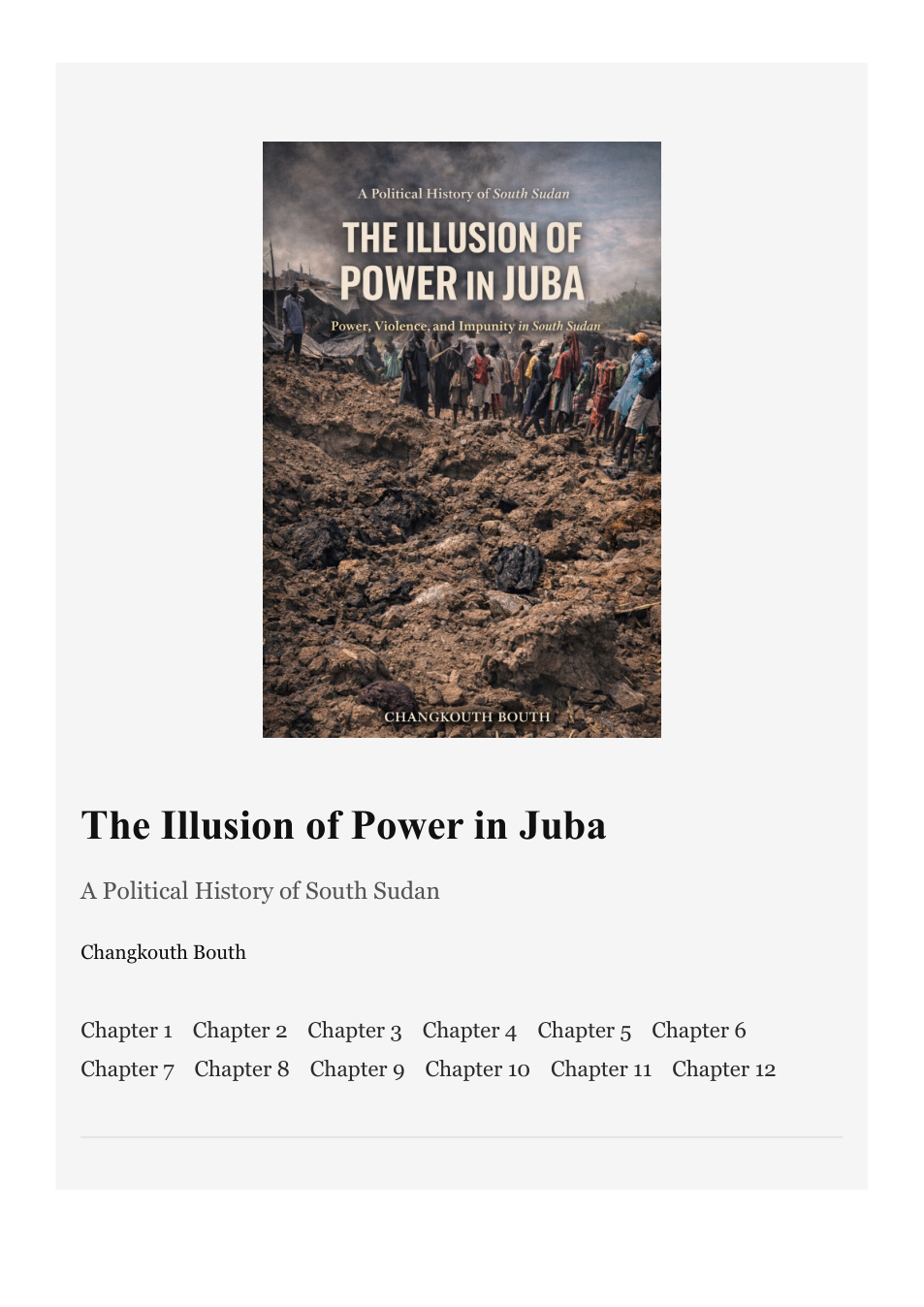
South Sudan’s political crisis is often described as a struggle over who controls Juba. Presidents, vice presidents, ministers, generals, party factions and armed movements have all treated control of the capital as the central measure of political power.
But the country’s experience since independence suggests that this definition of power is too narrow.
A government may control the presidency, the cabinet, the security apparatus and the national budget while still presiding over weak institutions, unpaid public servants, failing infrastructure, limited healthcare, disrupted education and fragile justice systems. Political dominance can therefore coexist with administrative weakness.
That is the central contradiction explored in The Illusion of Power in Juba: the appearance of power can be strongest precisely where the capacity of the state is weakest.
Independence inherited a movement, not a fully formed state
South Sudan entered independence in 2011 with extraordinary political legitimacy but limited institutional depth.
The liberation movement had developed structures designed to survive war, maintain command and preserve political unity under conditions of conflict. Those structures were not the same as the institutions required to run a modern civilian state.
As the book argues in its opening chapters, the transition from liberation movement to governing institution remained incomplete. Loyalty, military hierarchy and personal authority continued to shape public administration long after independence.
This matters because states are not built by declarations of sovereignty alone. They are built through predictable institutions: a professional civil service, functioning courts, transparent budgeting, accountable security forces, reliable revenue systems and local administrations capable of delivering services.
South Sudan gained international recognition faster than it built those systems.
Centralization created control, but not capability
One response to weak institutions was to centralize decision-making.
In theory, concentrating authority can make government more decisive. In practice, excessive centralization can weaken the very institutions a government needs.
When ministries depend on political personalities rather than rules, officials wait for instructions instead of exercising lawful authority. When appointments are treated primarily as instruments of political loyalty, professional competence becomes secondary. When security institutions become more powerful than civilian institutions, public administration begins to operate through fear rather than procedure.
This produces a state that may look powerful from the centre but becomes increasingly hollow underneath.
Control is not capacity
Control means the ability to dominate political institutions, appointments, security structures or access to state resources.
Capacity means the ability of institutions to perform their functions consistently, lawfully and effectively — regardless of which individual holds office.
Oil revenue concealed institutional weakness
Oil income gave the new state access to substantial resources, but revenue alone could not substitute for institutional development.
The book repeatedly returns to the gap between national wealth and public outcomes. Roads remained inadequate, public salaries were unreliable, health services depended heavily on external support and education systems struggled to meet basic demand.
The deeper problem was not simply insufficient money. It was the weakness of systems governing how money was allocated, audited and converted into public goods.
Where institutions are weak, natural-resource wealth can reinforce political patronage rather than state capacity. Revenue becomes something distributed through networks of influence instead of something invested through transparent national priorities.
The result is a paradox: a government may possess valuable natural resources while citizens experience the state primarily through scarcity.
Security became the most visible face of the state
Another theme running through the book is the expansion of security power as civilian institutions weakened.
When citizens encounter the state more often through soldiers, police, checkpoints and security officials than through teachers, doctors, courts, municipal services or functioning ministries, the meaning of government changes.
The state becomes associated with coercion rather than provision.
That imbalance has long-term consequences. Security institutions can suppress immediate threats, but they cannot replace schools, hospitals, courts or accountable local government. Military control may contain opposition temporarily, but it cannot create economic productivity or institutional legitimacy.
A functioning state requires security. But security without public administration is not state-building.
Conflict deepened the institutional crisis
The conflict that erupted in December 2013 did more than kill and displace civilians. It accelerated institutional deterioration.
Public resources were redirected toward survival and war. Administrative systems fragmented. Professionals fled. Infrastructure was destroyed or neglected. Humanitarian organisations assumed functions that ordinarily belong to government.
Over time, emergency arrangements risked becoming permanent arrangements.
When international agencies provide food, health services, shelter and education for large parts of the population, they save lives. But the continued dependence of citizens on humanitarian structures also reveals the weakness of domestic state capacity.
The issue is not whether humanitarian organisations should withdraw. It is whether the state is becoming capable of progressively assuming the responsibilities for which sovereign governments exist.
Peace agreements have often redistributed offices rather than rebuilt institutions
South Sudan’s peace processes have repeatedly focused on the distribution of political positions.
This is understandable. In a divided political system, power-sharing can reduce incentives for armed confrontation. But power-sharing becomes insufficient when it is treated as the principal measure of peace implementation.
A government can add vice presidents, ministries, commissions and political appointments without improving the effectiveness of the state.
Institutional reform asks different questions: Are courts independent? Are public accounts audited? Are civil servants paid predictably? Can counties deliver services? Are procurement systems transparent? Do security forces operate under law? Can citizens obtain government documents without political connections?
These are less dramatic than negotiations over senior offices, but they determine whether peace changes daily life.
Juba’s dominance can obscure the condition of the country
The geography of power also matters.
National politics is heavily concentrated in Juba, while the majority of citizens experience government through states, counties, payams and local communities.
A decision may be announced in the capital but never implemented in a distant county. A ministry may exist on paper while lacking staff, transport, electricity or operational budgets outside Juba.
State capacity therefore cannot be measured only by what happens inside national ministries.
A functioning South Sudanese state must work in Malakal, Wau, Bor, Bentiu, Torit, Yambio, Kuajok, Rumbek, Aweil and throughout rural counties — not merely around the institutions of the capital.
The cost of personalized institutions
When institutions depend too heavily on individuals, every leadership change becomes disruptive.
Officials are replaced, policies are abandoned, administrative priorities shift and public institutions become extensions of political networks.
Strong states behave differently. Ministers may change, but ministries continue. Governments may lose elections, but courts continue. Governors may be replaced, but state administrations continue.
This continuity is one of the defining characteristics of institutional capacity.
South Sudan’s challenge is therefore not simply finding better leaders. It is constructing institutions that do not require exceptional leaders in order to function.
What would functioning state capacity look like?
The answer does not require an abstract theory of government. Citizens already know what functioning institutions would mean in practical terms.
- Public servants receiving salaries predictably.
- Schools operating throughout the academic year.
- Health facilities with medicines, staff and basic equipment.
- Roads and waterways that allow people and goods to move safely.
- Courts capable of resolving disputes without political interference.
- Transparent publication of budgets, revenue and public contracts.
- Professional security forces accountable to civilian law.
- State and county administrations with real operating capacity.
- Elections that allow citizens to periodically renew or withdraw political authority.
These are not luxuries. They are the everyday architecture of a functioning state.
Power that cannot deliver eventually loses legitimacy
The central lesson of South Sudan’s post-independence experience is that political control has limits.
A government can dominate institutions without strengthening them. It can control the security apparatus without providing security in the broader human sense. It can possess oil wealth without producing development. It can occupy the machinery of the state without making that machinery work.
This is why the distinction between power and capacity matters.
Real state-building begins when institutions become stronger than the individuals who occupy them, when public resources are converted into public services, and when citizens experience government as something that works for them rather than something that merely rules over them.
South Sudan’s next political chapter should therefore be judged not only by who controls Juba.
It should be judged by whether the country finally develops institutions capable of functioning beyond Juba — and beyond any single leader, party or political settlement.