From Nile Dispute to Regional Confrontation: What the Ethiopia–Egypt Escalation Means for South Sudan
Fighting in northern Ethiopia and diplomatic expulsions have raised the stakes. South Sudan faces exposure through people, trade and oil transit, even without evidence that Juba has joined the confrontation.
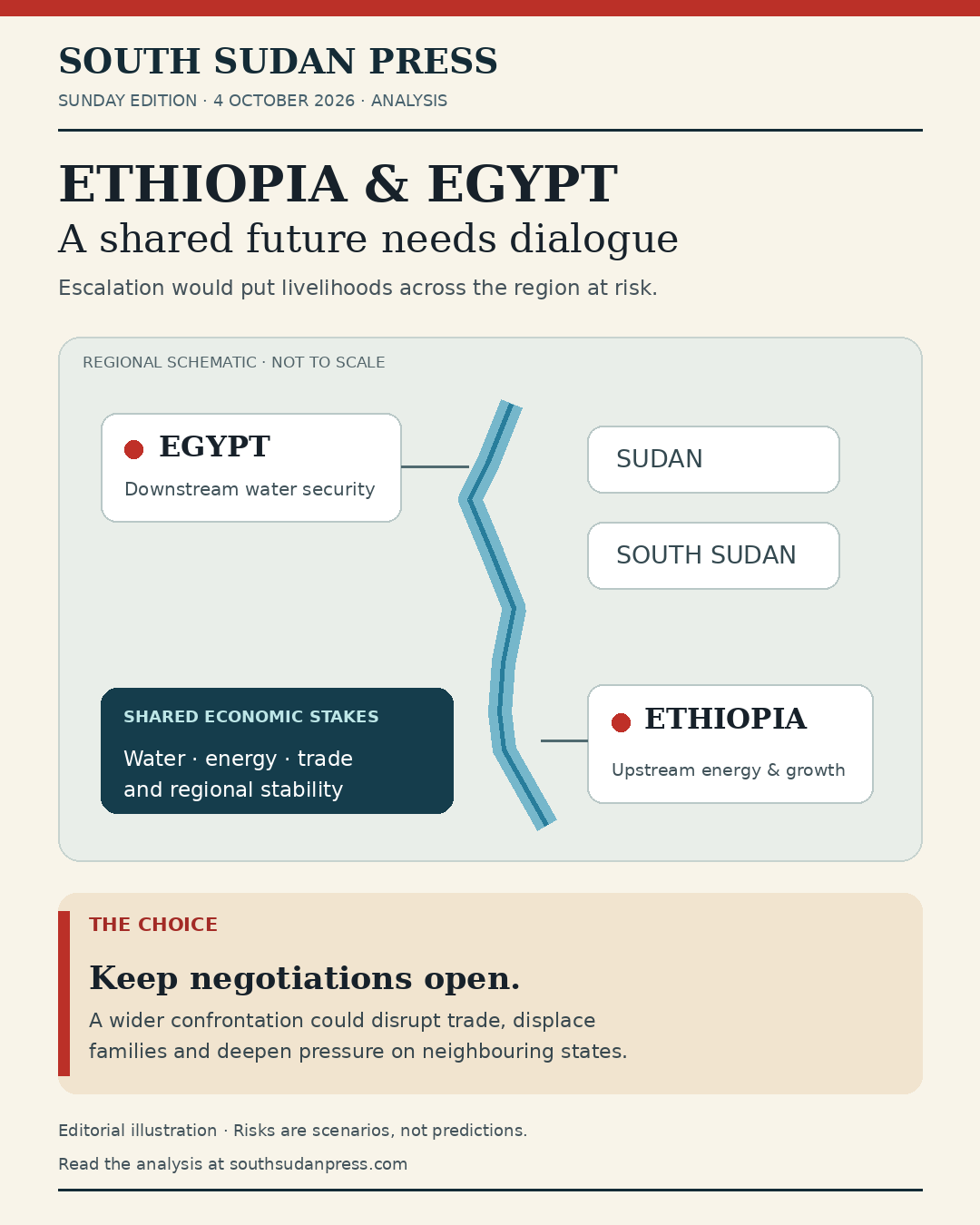
JUBA — Renewed fighting in northern Ethiopia is unfolding alongside a diplomatic rupture involving Ethiopia, Eritrea and Egypt. Addis Ababa has also accused Sudan of supporting its armed opponents. Egypt, Sudan and Eritrea deny Ethiopia’s allegations. The African Union’s 1 October statement urged Ethiopia, Eritrea and Egypt to exercise restraint and use diplomacy.
On 3 October, Reuters reported, citing three sources, that Ethiopian federal troops had retaken Alula Aba Nega Airport in Mekelle. Its report did not establish durable federal control of the whole city. The new hostilities began on 23 September, and IGAD had already called for a halt to fighting, protection of civilians and respect for the 2022 Pretoria agreement.
How a domestic war became a regional alarm
Reuters reported that Ethiopia closed its embassy in Asmara and ordered 10 Eritrean diplomats out, after which Eritrea severed diplomatic ties. Ethiopia expelled an Egyptian diplomat; Cairo responded by expelling an Ethiopian embassy official. These moves are concrete escalations, although reciprocal expulsions do not themselves constitute war.
Several disputes overlap: the Ethiopian conflict and its fragile peace settlement; Ethiopia and Eritrea’s deteriorating relationship, including tensions over access to the Red Sea; the Nile dam dispute between Ethiopia and Egypt; and Sudan’s civil war. The existence of these disputes does not prove a single coordinated military front. It means that incidents and unverified allegations can carry wider consequences.
Why Sudan is exposed
Sudan borders the conflict area and has been named in Ethiopia’s accusations, which Khartoum denies. Its own war makes the Ethiopia–Sudan frontier vulnerable to allegations about arms, fighters and drone movements. The unresolved Al-Fashaga border dispute offers another possible flashpoint. The immediate risk is limited cross-border incidents or covert support claims; a conventional interstate war is a different and more demanding threshold. Independent evidence about actual state sponsorship or deployment remains essential.
What South Sudan could face
Displacement and protection. Fighting in Ethiopia and Sudan could increase arrivals or movement near Upper Nile, Jonglei and Gambella. UNHCR’s 2026 South Sudan response plan already describes pressure at Renk and Maban from Sudan-related arrivals and flooding. It is a preparedness baseline, not evidence that the latest Ethiopian fighting has caused a new influx into South Sudan.
Oil and public finances. South Sudan relies on transit through Sudan for oil exports. The World Bank documented severe revenue losses from earlier oil disruption. Renewed threats to pipeline or port operations could therefore affect salaries and services, but no new interruption caused by this Ethiopia–Egypt crisis has been established.
Trade and civilian security. Insecurity in Sudan, Ethiopia and transport routes could raise the cost of food, fuel and humanitarian logistics. Border communities in Renk, Maban, Maiwut and Longochuk merit monitoring, as do routes toward Jonglei. These are potential exposure points, not verified reports of new incursions or price shocks.
Diplomatic pressure. Cairo and Addis Ababa may seek statements or alignment from Juba. There is no verified report that either has requested South Sudanese military access. Juba’s room for neutrality would narrow substantially if any foreign force, weapons transfer or attack were traced to South Sudanese territory.
Three scenarios to watch
| Scenario | What would indicate it | South Sudan consequence |
|---|---|---|
| Diplomatic containment | AU or IGAD talks; embassy contact restored; reduced fighting | Existing refugee and trade pressures continue, without a new regional shock |
| Prolonged proxy confrontation | Credibly documented cross-border material support, repeated incidents, expanding displacement | Border protection, aid capacity and transit costs face added pressure |
| Open interstate escalation | Verified direct clashes or strikes between national forces | Severe risks to displacement routes, trade, oil transit and regional diplomacy |
These are editorial scenarios, not forecasts. The information available does not justify precise probability scores. The most immediate practical task is to verify border movements, humanitarian arrivals and any official requests made to Juba, rather than to assume South Sudan has already entered the conflict.
Questions for Juba and regional bodies
Will South Sudan state a position on de-escalation and neutrality? Have foreign governments requested logistical or security cooperation? What are the latest registered arrivals at Renk and crossings toward Gambella? Are oil transit facilities operating normally? Has IGAD scheduled a new mediation meeting? South Sudan Press will update this analysis when documentary evidence or official responses answer those questions.