FRIDAY, 23 OCTOBER 2026 · ANALYSIS · ELECTION SECURITY
An Election-Security Plan Needs More Than a Coordination Meeting
Authority, funding, local access and independent complaints are the practical tests for the framework proposed in the editorial briefing.
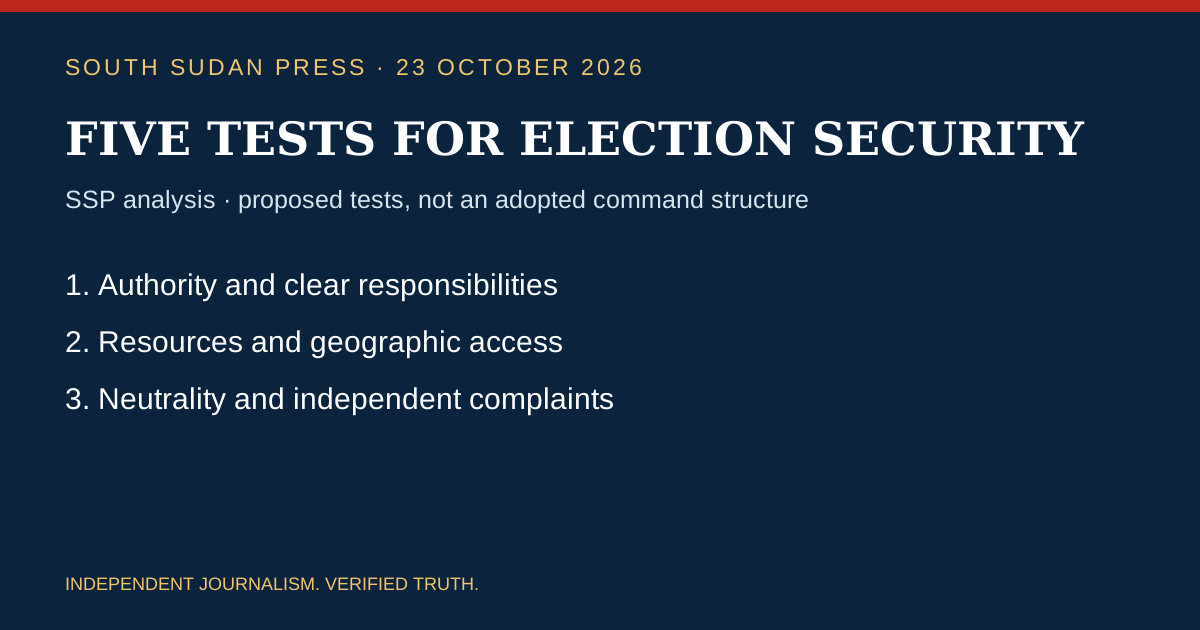
The proposal in the supplied editorial briefing to bring electoral institutions, monitors, UNMISS and national security agencies into a common framework is a starting point for analysis. It is not evidence that an agreed, funded or legally adopted plan already exists.
First comes authority. A published plan should identify which body makes each decision, the instrument authorising it and how disputes are escalated. Cooperation cannot be assumed to give one institution powers belonging to another. This article does not offer a legal determination that a proposed arrangement is valid.
Second comes the separation of tasks. Recording an allegation, observing a deployment, investigating a crime and providing protection are different functions. A useful plan would assign them explicitly, with participating institutions stating their roles rather than relying on a shared label of election security.
Third comes cost. A deployment schedule without transport, communications, accommodation and maintenance is difficult to assess. The public needs an understandable account of the available resources, remaining gaps and decisions that depend on additional funding. It need not expose sensitive operational details.
Fourth comes geographic access. Planning should start with the journey a voter or election worker must make, including the approach to a registration location and the way home. The same exercise should consider people with disabilities, displaced families and communities whose access varies with road conditions.
Fifth comes political neutrality. A deployment may deter violence while still intimidating a particular community. Clear conduct rules, limits on political activity and a complaint route outside the immediate local chain of command would make that risk easier to detect and address.
Oversight should include opportunities for political parties, civil society and affected communities to report concerns. Their participation would not give them operational command. It would create a way to challenge an uneven pattern of protection or access before it hardens into an accepted practice.
Finally, the plan should be tested against a practical incident: a road becomes inaccessible, an official is threatened or a community reports intimidation. Who records the report, who responds, who informs the NEC and how is the complainant protected? A documented answer would show more about readiness than another general assurance.
The central test is therefore an authorised and resourced set of responsibilities that communities can understand and question. Whether December’s timetable remains in place is separate from whether those conditions have been demonstrated.
Sources reviewed for the 23 October edition. Statements, estimates and findings are distinguished in the text. SSP has not independently conducted interviews or field verification for this report.